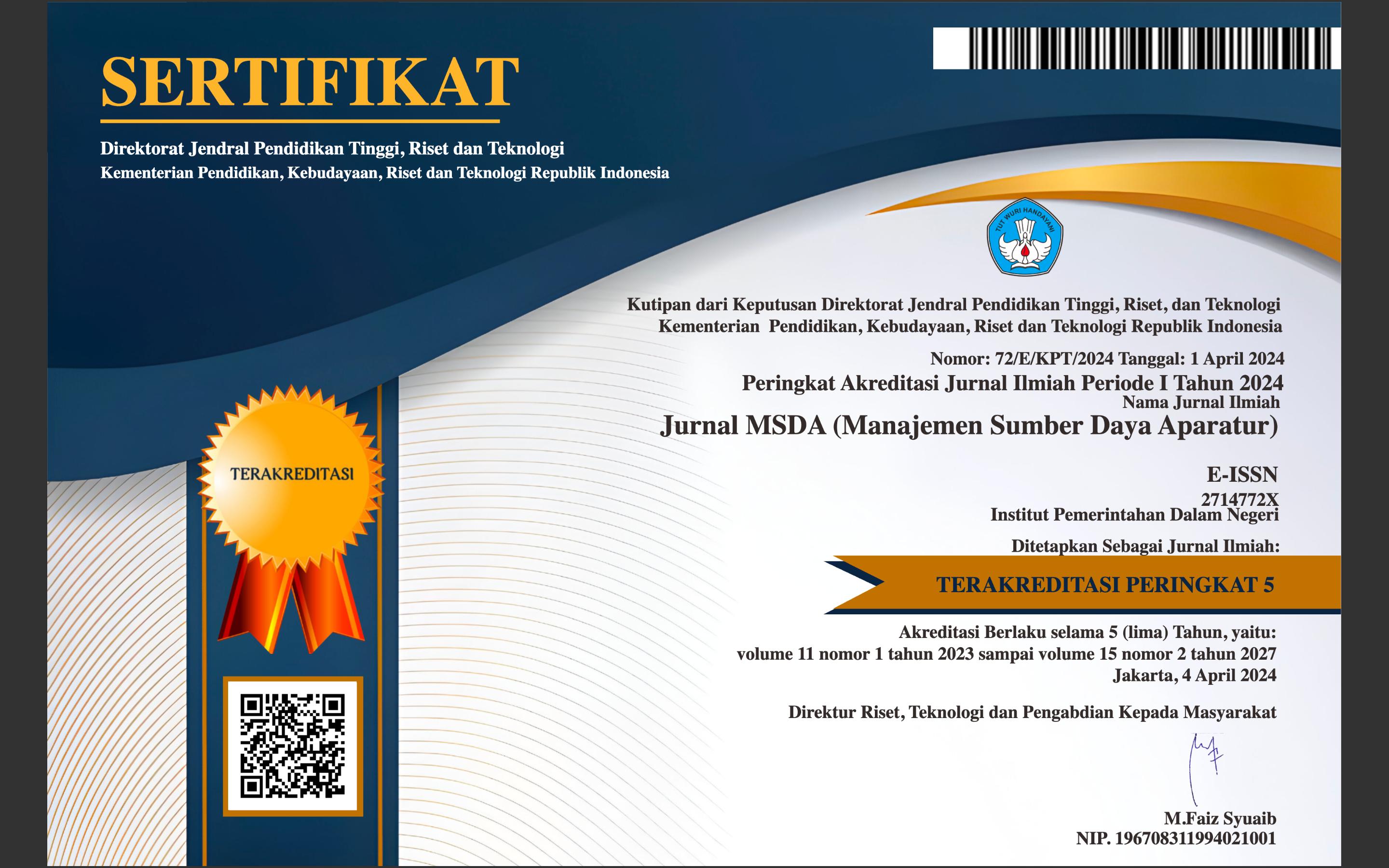
Driving Meaningful Innovation for Human Resources in the Public Sector: A Systematic Literature Review
DOI:
https://doi.org/10.33701/jmsda.v14i1.6277Keywords:
Human Resources, Meaningful Innovation, Public Sector, Systematic Literature ReviewAbstract
Human resource innovation in the public sector is crucial for organizational adaptability and resilience, yet knowledge on how to foster meaningful innovation remains limited. This study aims to answer the question: how can we drive meaningful innovation in human resources in the public sector? Using the Systematic Literature Review (SLR) method, this study extracted a total of 1,190 Scopus articles and identified 24 relevant and high-quality articles from the Scopus database (2016–2026) for further analysis. The analysis identified four main, systemically interrelated themes to foster human resource innovation in the public sector. First, leadership that builds a safe psychological climate and a culture of innovation. Second, human-centered human resource management practices, particularly recognition, inclusion, locally specific training, innovation standards in performance evaluation, and the creation of new roles. Third, employee psychological capacity and internal motivation, including proactive motivation, paradox mindset, and compassion. Fourth, equitable digital governance, where human resources information system and human resource analytics technologies are complementary and only meaningful if supported by capabilities, motivation, opportunities, and guarantees of algorithmic fairness. The conclusions of this study confirm that meaningful public human resource innovation is not generated by a single factor, but rather by the systemic interaction between these four pillars. Consequently, public leaders need to shift their focus from rigid procedures to human empowerment, and ensure that every innovation intervention is holistic and contextual.
Downloads
References
Abdul Ghani Azmi, I., & Hashim, J. (2022). Do HRM practices facilitate innovation? A qualitative study in a developing country. Innovation & Management Review, 19(4), 368–381.
Abdul, S., Adeghe, E. P., Adegoke, B. O., Adegoke, A. A., & Udedeh, E. H. (2024). Public-private partnerships in health sector innovation: Lessons from around the world. Magna Scientia Advanced Biology and Pharmacy, 12(1), 45–59.
Ahmad, A., Saleem, S., Shabbir, R., & Qamar, B. (2024). Paradox mindset as an equalizer: A moderated mediated perspective on workplace ostracism. Plos One, 19(2), e0294163.
Ali, K. A. M., & Buang, M. (2016). Study on factors that influence innovation in Malaysian public sector. Journal of Advanced Research in Business and Management Studies, 4(1), 60–73.
Amoako, R., Jiang, Y., Adu-Yeboah, S. S., Frempong, M. F., & Tetteh, S. (2023). Factors influencing electronic human resource management implementation in public organisations in an emerging economy: An empirical study. South African Journal of Business Management, 54(1), 2937.
Arundel, A., Bloch, C., & Ferguson, B. (2019). Advancing innovation in the public sector: Aligning innovation measurement with policy goals. Research Policy, 48(3), 789–798.
Bhamra, R., & Brodersohn, E. (2025). Understanding organizational dynamism: Fostering creativity and agility for resilience in social security institutions. International Social Security Review, 78(2–3), 37–54.
Blackman, D., Buick, F., Johnson, S., Rooney, J., & Ilahee, N. (2022). Using system traps to understand and potentially prevent human resource development intervention failure. Human Resource Development Quarterly, 33(1), 47–67.
Bruns, E. J., Parker, E. M., Hensley, S., Pullmann, M. D., Benjamin, P. H., Lyon, A. R., & Hoagwood, K. E. (2019). The role of the outer setting in implementation: associations between state demographic, fiscal, and policy factors and use of evidence-based treatments in mental healthcare. Implementation Science, 14(1), 96.
Caravella, S., & Crespi, F. (2021). The role of public procurement as innovation lever: evidence from Italian manufacturing firms. Economics of Innovation and New Technology, 30(7), 663–684.
Cavanagh, J., Pariona‐Cabrera, P., & Halvorsen, B. (2023). In what ways are HR analytics and artificial intelligence transforming the healthcare sector? Asia Pacific Journal of Human Resources, 61(4), 785–793.
Cedergren, A., & Hassel, H. (2024). Building organizational adaptive capacity in the face of crisis: Lessons from a public sector case study. International Journal of Disaster Risk Reduction, 100, 104235.
Chughtai, M. S., Syed, F., Naseer, S., & Chinchilla, N. (2024). Role of adaptive leadership in learning organizations to boost organizational innovations with change self-efficacy. Current Psychology, 43(33), 27262–27281.
Cinar, E., Simms, C., Trott, P., & Demircioglu, M. A. (2024). Public sector innovation in context: A comparative study of innovation types. Public Management Review, 26(1), 265–292.
Couture, J. L., Blake, R. E., McDonald, G., & Ward, C. L. (2018). A funder-imposed data publication requirement seldom inspired data sharing. PLoS One, 13(7), e0199789.
Criado, J. I., Alcaide-Muñoz, L., & Liarte, I. (2025). Two decades of public sector innovation: building an analytical framework from a systematic literature review of types, strategies, conditions, and results. Public Management Review, 27(3), 623–652.
Danquah, M., & Amankwah-Amoah, J. (2017). Assessing the relationships between human capital, innovation and technology adoption: Evidence from sub-Saharan Africa. Technological Forecasting and Social Change, 122, 24–33.
Demircioglu, M. A., & Audretsch, D. B. (2017). Conditions for innovation in public sector organizations. Research Policy, 46(9), 1681–1691.
Franco, C., & Landini, F. (2022). Organizational drivers of innovation: The role of workforce agility. Research Policy, 51(2), 104423.
Gong, Y., & Li, X. (2023). Designing boundary resources in digital government platforms for collaborative service innovation. Government Information Quarterly, 40(1), 101777.
Gorgievski, M. J., Bakker, A. B., Petrou, P., & Gawke CL, J. (2023). Antecedents of employee intrapreneurship in the public sector: a proactive motivation approach. International Public Management Journal, 26(6), 852–873.
Hasan, A. (2026). Innovation in public administration amid social and global turbulence: strategic adaptation and key challenges. ECOBIZTECH: Journal of Economics, Business, and Technology, 1(1), 64–79.
Horák, P., Špaček, D., & Špalková, D. (2026). Resilience of public sector organisations and factors that influence resilience. Asia Pacific Journal of Public Administration, 1–24.
Hülter, S. M., Ertel, C., & Heidemann, A. (2024). Exploring the individual adoption of human resource analytics: Behavioural beliefs and the role of machine learning characteristics. Technological Forecasting and Social Change, 208, 123709.
Kim, M. Y., & Kim, S. W. (2022). Deriving public innovation capacity: Evidence from the korean public sector. Frontiers in Psychology, 13, 898399.
Kim, P. S. (2022). A behavioral approach to administrative reform: a case study of promoting proactive administration in South Korea. Public Administration and Policy, 25(3), 310–322.
Kyeong, K. (2026). When autonomy backfires or succeeds: curvilinear effects on innovative behaviour in the public sector and the moderating role of transformational leadership. Public Management Review, 1–30.
Lister, C., Payne, H., Hanson, C. L., Barnes, M. D., Davis, S. F., & Manwaring, T. (2017). The public health innovation model: merging private sector processes with public health strengths. Frontiers in Public Health, 5, 192.
Lopes, A. V., & Farias, J. S. (2022). How can governance support collaborative innovation in the public sector? A systematic review of the literature. International Review of Administrative Sciences, 88(1), 114–130.
MacGregor, H., McKenzie, A., Jacobs, T., & Ullauri, A. (2018). Scaling up ART adherence clubs in the public sector health system in the Western Cape, South Africa: a study of the institutionalisation of a pilot innovation. Globalization and Health, 14(1), 40.
Marshall, S., Tsegai, D., Lintott, M., Carnelley, T., Lee, S., & Kurbis, C. (2025). Implementation of a paraprofessional role across the public health sector in Manitoba: Impacts on system capacity. Canadian Journal of Public Health, 116(2), 327–334.
Mazur-Wierzbicka, E. (2019). Human resources as fundamental element determining the development of innovation.
McGann, M., Blomkamp, E., & Lewis, J. M. (2018). The rise of public sector innovation labs: experiments in design thinking for policy. Policy Sciences, 51(3), 249–267.
Misuraca, G., & Viscusi, G. (2020). AI-enabled innovation in the public sector: A framework for digital governance and resilience. International Conference on Electronic Government, 110–120.
Moussa, M., McMurray, A., & Muenjohn, N. (2018). A conceptual framework of the factors influencing innovation in public sector organizations. The Journal of Developing Areas, 52(3), 231–240.
Mu, R., & Wang, H. (2022). A systematic literature review of open innovation in the public sector: Comparing barriers and governance strategies of digital and non-digital open innovation. Public Management Review, 24(4), 489–511.
Natsir, N., Halim, R., & Tahili, M. H. (2023). The effect of dynamic governance on public service innovation through the recruitment of managers of public organizations. Public Policy and Administration, 22(4), 405–417.
Nishimura, A. Z. F. C., Moreira, A., Sousa, M. J., & Au-Yong-Oliveira, M. (2021). Weaknesses in motivation and in establishing a meritocratic system: A portrait of the Portuguese public administration. Administrative Sciences, 11(3), 87.
Palm, K., Fredriksson, S., Silfversten, E., & Özbek, N. (2024). Exploring systemic design practices in public sector innovation. Policy Design and Practice, 7(3), 361–375.
Pater, R., & Lewandowska, A. (2015). Human capital and innovativeness of the European Union regions. Innovation: The European Journal of Social Science Research, 28(1), 31–51.
Pradana, I. P. Y. B., Susanto, E., & Kumorotomo, W. (2022). Analyzing the critical factors for innovation sustainability in the public sector: evidence from Indonesia. International Journal of Public Sector Management, 35(7), 733–748.
Rahman, A., Sahar, A. R., Putra, F., & Diliawan, R. (2018). Does Leadership Background Matter In Performance Of Local Government? 2018 Annual Conference of Asian Association for Public Administration:" Reinventing Public Administration in a Globalized World: A Non-Western Perspective"(AAPA 2018), 541–550.
Rahman, A., Wulandari, S., Marsitadewi, K. E., Nangameka, T. I., & Rogi, S. A. T. (2026). The Dynamics of Public Policy-Making in Public Administration: From Classical Management to the New Public Administration. Journal of Contemporary Governance and Public Policy, 7(1), 63–82.
Ririh, K. R., Machfud, M., Anggraeni, E., & Rochman, N. T. (2025). The way of human resource development and resource/infrastructure management affect the agroindustrial innovation process in a merged public research institution. Intangible Capital, 21(1), 45–61.
Satispi, E., Rajiani, I., Murod, M., & Andriansyah, A. (2023). Human resources information system (HRIS) to enhance civil servants’ innovation outcomes: compulsory or complimentary? Administrative Sciences, 13(2), 32.
Spännäri, J., Juntunen, E., Pessi, A. B., & Ståhle, P. (2023). Compassion—A key to innovation: What promotes and what prevents innovation in organizations? Frontiers in Psychology, 14, 1058544.
Tan, A. B. C., Van Dun, D. H., & Wilderom, C. P. M. (2021). Innovative work behavior in Singapore evoked by transformational leaders through innovation support and readiness. Creativity and Innovation Management, 30(4), 697–712.
Torvinen, H., & Jansson, K. (2023). Public health care innovation lab tackling the barriers of public sector innovation. Public Management Review, 25(8), 1539–1561.
Villa Alvarez, D. P., Auricchio, V., & Mortati, M. (2022). Mapping design activities and methods of public sector innovation units through the policy cycle model. Policy Sciences, 55(1), 89–136.
Vivona, R., & Lewis, J. M. (2025). The entrepreneurial public servant: Unlocking employee potential through recognition and inclusion. Review of Public Personnel Administration, 45(1), 56–76.
Wu, J., Chen, D., Bian, Z., Shen, T., Zhang, W., & Cai, W. (2021). How does green training boost employee green creativity? A sequential mediation process model. Frontiers in Psychology, 12, 759548.
Xiao, F.-X., Lin, Y., Kuang, J.-F., Yang, L.-L., & Wang, Q. (2025). How and when servant leadership affect public employees’ innovative behavior. Scientific Reports, 15(1), 26705.
Downloads
-
568Views
-
143Downloads
Downloads
Published
How to Cite
Issue
Section
License
Copyright (c) 2026 Jurnal MSDA (Manajemen Sumber Daya Aparatur)

This work is licensed under a Creative Commons Attribution 4.0 International License.