
Vol. 17 No. 2 (2025): Regional and Local Government Resources
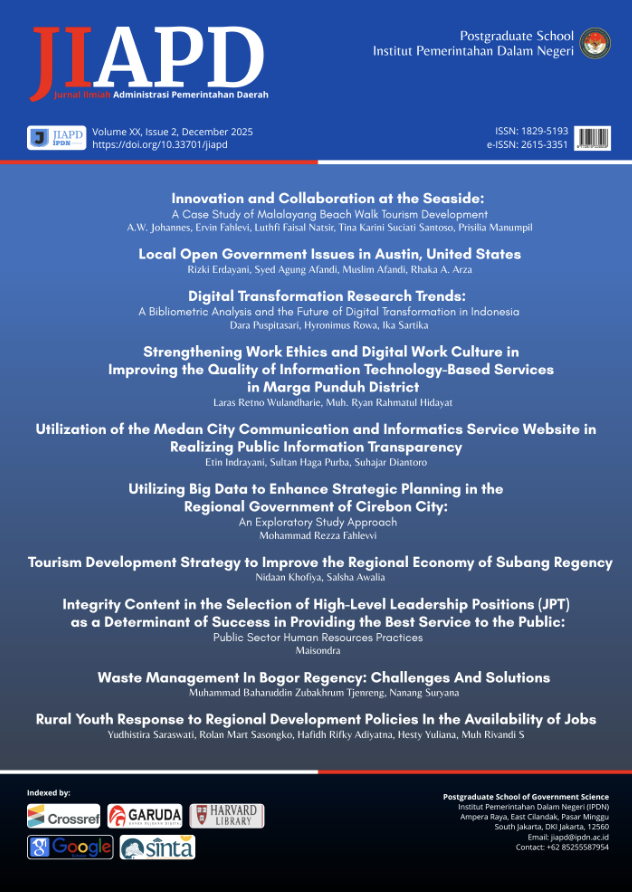
The Scientific Journal of Regional Government Administration, Volume 17, Number 2, 2025, raised the theme "Regional and Local Government Resources," addressing the current challenges in managing increasingly complex, cross-sectoral, and interregional regional and local government resources. This theme emphasizes that regional government resources are no longer limited to fiscal and bureaucratic aspects, but also encompass political, digital, social, institutional, spatial, and knowledge and technological resources. The published articles demonstrate how these resources are produced, managed, contested, and utilized in diverse contexts. The study, "Students' Perceptions of the Malaysian Election Manifesto," reflects on political resources and public legitimacy as crucial governance assets. Meanwhile, the studies, "Digital Adoption by the Banjarmasin City Communications and Information Agency" and "Digital Transformation and the Effectiveness of E-Governance in the Malaysian Public Sector," highlight technological resources and regional institutional capacity in responding to the demands of adaptive public services.
The fiscal and data resource dimensions are further enhanced by the article, "Integration of Data Science and AI for West Java Regional Budget Analysis," demonstrating how data-driven knowledge is a strategic asset in regional planning and decision-making. Issues of cross-border governance and social cohesion are addressed in the study "The Indonesia–Malaysia Border Region," which highlights the imbalance in autonomy policies as a factor in weakening local loyalty. Another aspect concerns "Regional Expansion and Fiscal Dependence." Meanwhile, the article on "Merangin Geopark Development" expands the meaning of regional resources to encompass ecological, cultural, and sustainable tourism. The volume concludes with a study on "Decision-Making Processes in the Guwosari Government," which emphasizes the importance of procedural resources and local leadership.
Interestingly, this edition includes authors and cases from four countries: Indonesia, Malaysia, Australia, and the United States, representing studies across three continents: Asia, the European Union, and the Americas. This diversity enriches comparative perspectives and underscores the global relevance of the issue of regional governance resources to contemporary government administration.
Published:
31-12-2025