
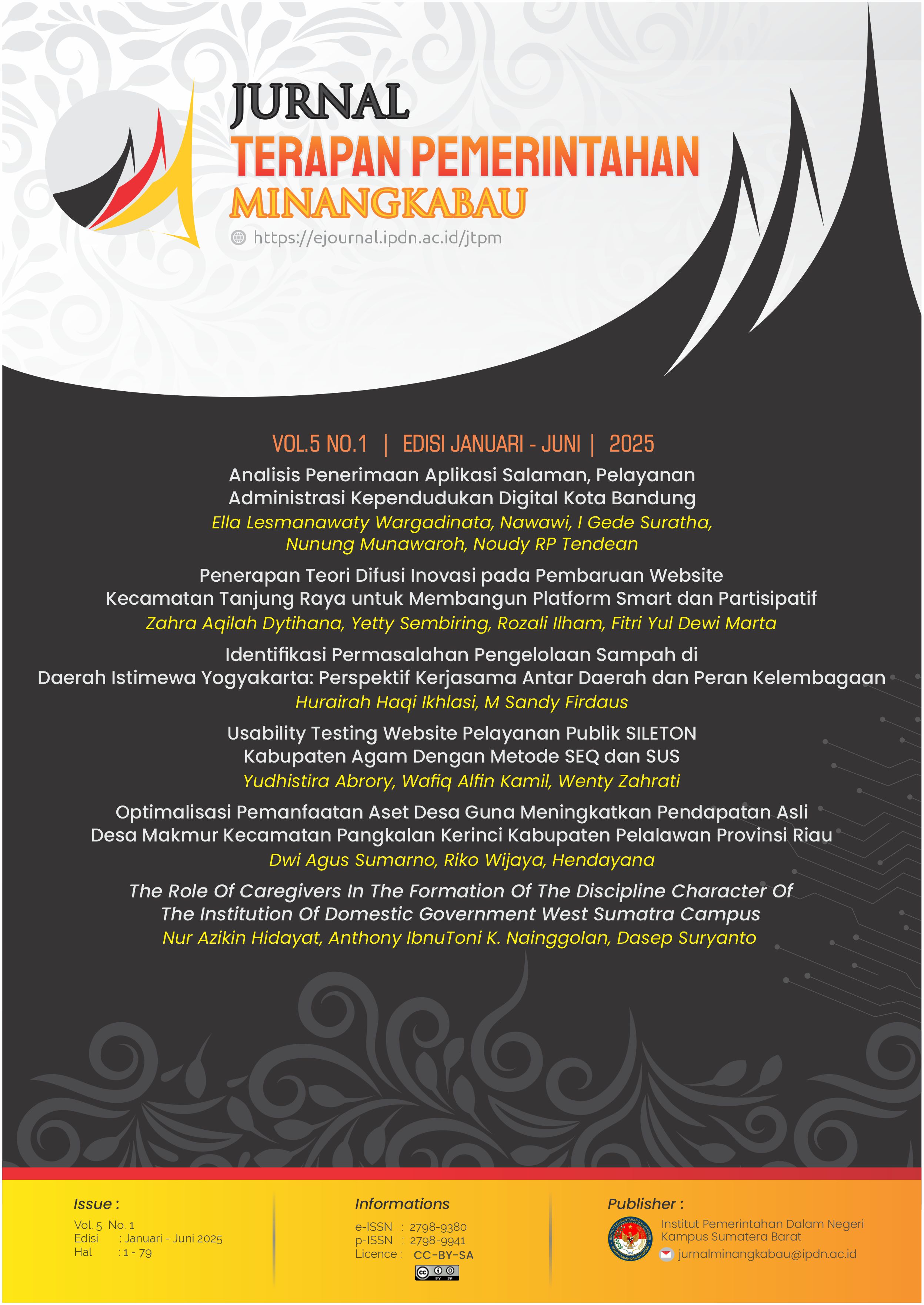
Analisis Penerimaan Aplikasi Salaman, Pelayanan Administrasi Kependudukan Digital Kota Bandung
DOI:
https://doi.org/10.33701/jtpm.v5i1.4899Keywords:
Innovation, Digitalization, Digital Divide, InsentifAbstract
The Salaman application is an online population administration service in Bandung, launched at the end of 2018. The application developed rapidly during the COVID-19 period and is still maintained as a public service innovation to this day. The Salaman application is considered a good application, with complete features, accessible language, and good security, but why is this application not fully used by the residents of Bandung City? The research uses the basic theory of the TAM-Technology Acceptance model from Davis (1989). The research method uses kuantitativemethods, SEM statistical tests for quantitative, and the Nvivo program for qualitative, which are used as data analysis instruments. Data sources include primary data from questionnaires, interviews, observations, and secondary data from various official documents and research by the research focus. The analysis results show that users will receive the Salaman application because it has 1) benefits, 2) makes it easy, and 3) is interesting to use as a population service. All variables positively and significantly influence the acceptance and use of the Salaman application. All variables positively and significantly influence the acceptance and use of the Salaman application. However, the Salaman application has not been able to attract the majority of heads of families as digital immigrants because it is considered 1) complicated, 2) exclusive, 3) Limited services 4) Lack of dissemination 5) Technical Problems 6) Trust issue 7) Responsive 8) Capability. Suppose the Bandung City Government’s Disdukcapil office aims to transform Bandung into a digital city with entirely digitized population services. In that case, several strategic efforts are essential: 1) Providing training, mentoring, and incentives to prepare Bandung City residents for the Salaman Application, facilitating their transition into engaged smart city residents, 2)Minimizing conventional methods of innovation to expand the digital service market among Bandung City residents.3)Implementing comprehensive policy support and adopting a holistic approach to effectively prepare for the transformation of conventional population administration services into digital platforms.
References
Agolla, J., & Van Lill, J. (2013). Public Sector Innovation Drivers: A Process Model. J Soc Sci, 34(2), 165ÔÇô176.
Agustino, D. (2020). A Conversation with Dr. Suhariyanto, IndonesiaÔÇÖs Chief Statistician. UNFPA. https://indonesia.unfpa.org/en/news/conversation-dr-suhariyanto-indonesias-chief-statistician
Andhika, L., Nurasa, H., Karlina, N., & Candradewini. (2018). Governance Innovation in Civil Registration Record in Indonesian Local Government. Pakistan Administrative Review, 2(2), 276ÔÇô290.
Arias, M. I., & Ma├ºada, A. C. G. (2018). Digital Government for E-Government Service Quality: a Literature Review. ICEGOV 18, 7ÔÇô17. https://doi.org/10.1145/3209415.3209422
Bappenas. (2017). Civil registration and vital statistic (CRVS) in Indonesia.
Basu, S. (2004). E-Government and Developing Countries: An Overview. International Review of Law Computers & Technology, 18(1), 109ÔÇô132. https://doi.org/10.1080/13600860410001674779
Bertot, J. C., Estevez, E., & Janowski, T. (2016). Digital Public Service Innovation: Framework Proposal. ICEGOV 2016. https://doi.org/10.1145/12345.67890
Creswell, J. W., & Creswell, J. D. (2018). Research design: Qualitative, quantitative, and mixed methods approaches (Fifth edit). SAGE Publication.
Davis, F. D. (1989). Perceived Usefulness, Perceived Ease of Use, and User Acceptance of Information Technology. MIS Quarterly, 13(3), 319ÔÇô339. https://doi.org/DOI: 10.2307/249008
Elliott-Mainwaring, H. (2021). Exploring using NVivo software to facilitate inductive coding for thematic narrative synthesis. British Journal of Midwifery, 29(00), 2ÔÇô6. https://doi.org/http://dx.doi.org/10.12968/bjom.2021.29.11.628
Fatimah, S., Sriningsih, S., Pascayanti, Y., & Yusuf, F. (2023). Digital Divide Solutions and Public Service Policy Implementation in Indonesia after the Covid-19 Pandemic. 6(8), 3801ÔÇô3808. https://doi.org/https://doi.org/10.47191/jefms/v6-i8-30
Hafidati, P. (2022). Legal Protection of Population Administration in The Recording of Deeds The Birth of A Street Child in Indonesia. Al-Ahkam, 18(1), 25ÔÇô30.
Hair, J. F., Hult, G. T. M., Ringle, C. M., & Sarstedt, M. (2017). A Primer on Partial Least Squares Structural Equation Modeling (PLS-SEM) (2nd editio). Sage. https://eli.johogo.com/Class/CCU/SEM/_A Primer on Partial Least Squares Structural Equation Modeling_Hair.pdf
Hariyadi, S., Ronaza, C. A., & Putri, M. Z. (2021). Civil Registration: Is It a Right for Vulnerable Groups? Jurnal Perencanaan Pembangunan: The Indonesian Journal of Development Planning, 5(3), 317ÔÇô342. https://doi.org/Doi: 10.36574/jpp.v5i3.229
Hastuti. (2020). Petingnya pemanfaatan data kependudukan di era digital. TEKNIMEDIA, 1(1), 18ÔÇô21.
Hilal, A. H., & Alabri, S. S. (2013). Using NVivo for data analysis in qualitative research. International Interdisciplinary Journal of Education ÔÇô, 2(2), 181ÔÇô186. http://www.iijoe.org/v2/IIJOE_06_02_02_2013.pdf
Irawati, T., Rimawati, E., & Pramesti, N. A. (2019). Penggunaan Metode Technology Acceptance Model (TAM) Dalam Analisis Sistem Informasi Alista (Application Of Logistic And Supply Telkom Akses). @is The Best: Accounting Information Systems and Information Technology Business Enterprise, 4(2), 106ÔÇô120. https://doi.org/https://doi.org/10.34010/aisthebest.v4i02.2257
Ivankova, N. V., Creswell, J. W., & Stick, S. L. (2006). Using Mixed-Methods Sequential Explanatory Design: From Theory to Practice. Field Methods, 18(1), 3ÔÇô20. https://doi.org/DOI: 10.1177/1525822X05282260
Jayanthi, R., & Dinaseviani, A. (2022). Kesenjangan Digital dan Solusi yang Diterapkan di Indonesia selama Pandemi COVID-19. Jurnal IPTEK-KOM (Jurnal Ilmu Pengetahuan Dan Teknologi Komunikasi), 24(2), 187ÔÇô200. https://doi.org/https://doi.org/10.17933/iptekkom.24.2.2022.187-200
Jayasinga, I., & Triono, A. (2023). Digitalization of Population Administration to Facilitate Public Services in the Era of Regional Autonomy. International Journal of Multicultural and Multireligious Understanding (IJMMU), 10(5), 484ÔÇô490.
Junior, J. C. da S. F., Ma├ºada, A. C. G., J├║nior, D. de B. S., & Brinkhues, R. (2023). Sensing and Responsiveness: Digital Capabilities to Face the Challenges of the Digital Economy. Brazilian Journal of Marketing, 22(1421ÔÇô1446). https://doi.org/https://doi.org/10.5585/remark.v22i4.23912
Lynn, T., Rosati, P., Conwal, E., Curran, D., Fox, G., & OÔÇÖGorman, C. (2022). Digital Public Services. palgrave macmillan. https://doi.org/10.1007/978-3-030-91247-5
Mardhiyah, N. S., Rusydi, M., & Azwari, P. C. (2020). Analisis Technology Acceptance Model (TAM) terhadap penggunaan aplikasi GoJek pada mahsiswa di Kota Palembang. Esensi: Jurnal Bisnis Dan Manajemen, 10(2), 173ÔÇô180. https://doi.org/https://doi.org/10.15408/ess.v10i2.16455
Memona, M. A., Ramayah, T., Cheah, J.-H., Ting, H., Chuah, F., & Cham, T. H. (2021). PLS-SEM Statistical Programs: A Review. Journal of Applied Structural Equation Modeling, 5(1), iÔÇôxiv. https://doi.org/DOI: 10.47263/JASEM.5(1)06
Mikelsen, L., Lopez, A., & Phillips, D. (2015). Why birth and death registration really are ÔÇ£vitalÔÇØ statistics for development. https://hdr.undp.org/content/why-birth-and-death-registration-really-are-vital-statistics-development
Misran, Mualilidin, I., Nanaman, M. S., & Prasetyo, S. I. (2022). The Politicization of Population Data Governance in the Perspective of Principal-Agent. JUrnal Bina Praja, 14(2), 275ÔÇô287. https://doi.org/https://doi.org/10.21787/jbp.14.2022.275-287
Mulgan, G., & Albury, D. (2003). Innovation in the public sector (p. 40).
Nugroho, R. A. (2023, September 6). Bansos Salah Sasaran Bikin Negara Boncos Rp 523 M Per Bulan. CNBC Indonesia. https://www.cnbcindonesia.com/news/20230906094703-4-469745/bansos-salah-sasaran-bikin-negara-boncos-rp-523-m-per-bulan
Nurhadryani, Y., Hutomo, Y. S., Kurnia, A., Anisa, R., & Ramadhan, D. A. (2017). Karakteristik Digital Native dan Digital Immigrant Masyarakat Bogor Menuju E-Government. Seminar Nasional Sistem Informasi Indonesia (SESINDO), 137ÔÇô146.
Nurhidayat, D. (2023, June 15). Ombudsman: Data Penerima Bansos Harus Padu untuk Meminimalkan Salah Sasaran. Media Indonesia. https://mediaindonesia.com/humaniora/589851/ombudsman-data-penerima-bansos-harus-padu-untuk-meminimalkan-salah-sasaran
├ûstlund, U., Kidd, L., Wengstr├Âm, Y., & Rowa-Dewar, N. (2011). Combining qualitative and quantitative research within mixed method research designs: A methodological review. International Journal of Nursing Studies, 48(3), 369ÔÇô383. https://doi.org/doi: 10.1016/j.ijnurstu.2010.10.005
Pratama, A. B. (2020). The landscape of public service innovation in Indonesia A comprehensive analysis of its characteristic and trend. Innovation & Management Review., 17(1), 25ÔÇô40. https://doi.org/DOI 10.1108/INMR-11-2018-0080
Purba, N., & Gamaputra, G. (2018). The Role of Government in Population and Civil Registration Service Online (E-lampid). Advances in Social Science, Education and Humanities Research, 364ÔÇô368. https://www.ncbi.nlm.nih.gov/pmc/articles/PMC6249696/https://www.ncbi.nlm.nih.gov/pmc/articles/PMC6249696/
PwC. (2007). The road ahead for public service delivery. https://www.pwc.com/gx/en/psrc/pdf/the_road_ahead_for_public_service_delivery.pdf
Rahmi, M. A., Septian, E. R., & Kusumaningrum, S. (2020). Bridging Inclusion Understanding Vulnerability in IndonesiaÔÇÖs CRVS System.
Ramadhanti, H. D., & Astuti, E. T. (2022). Digital Divide and a Spatial Investigation of convergence in ICT development across Provinces in Indonesia. | Jurnal Aplikasi Statistika & Komputasi Statistik, V. Khusus, 69ÔÇô84.
Rokhmah, S., & Setyaningsih, P. W. (2020). Analiasis technology acceptance model (TAM) pada aplikasi e-learning di kalangan dosen dan mahasiswa ITB AAS Indonesia. PROSIDING SEMINAR NASIONAL ITB AAS INDONESIA TAHUN 2020, 210ÔÇô218.
Safarov, N. (2021). Personal experiences of digital public services access and use: Older migrantsÔÇÖ digital choices. Technology in Society, 66. https://doi.org/https://doi.org/10.1016/j.techsoc.2021.101627
Shorten, A., & Smith, J. (2017). Mixed methods research: expanding the evidence base. Evidence Based Nurse, 20(3), 74ÔÇô75. https://doi.org/10.1136/eb-2017-102699
Sianturi, J. (2018). Manipulasi pendaftaran pemilih pada PILKADA Kabupaten Toba Samosir Tahun 2015: Suatu studi tentang malpraktik dalam pemutakhiran daftar pemilih perspektif PEMILU berintegritas. UNAIR.
Trischler, J., & Trischler, J. W. (2022). Design for experience ÔÇô a public service design approach in the age of digitalization. Public Management Review, 24(8), 1251ÔÇô1270. https://doi.org/e: https10.1080/14719037.2021.1899272
Urbach, N., & Ahleman, F. (2010). Structural equation modeling in information systems research using Partial Least Squares. Journal of Information Technology Theory and Application, 11(2), 5ÔÇô40.
Vebrianto, R., Thahir, M., Putriani, Z., & Diniya, D. (2020). Mixed Methods Research: Trends and Issues in Research Methodology. Bedelau: Journal of Education and Learning, 1(1), 63ÔÇô73.
Venkatesh, V., & Davis, F. . (1996). A Critical Assessment of Potential Measurement Biases in the Technology Acceptance Model: Three Experiments. Three Experiments. International Journal of HumanComputer Study, 45(1), 19ÔÇô45. https://doi.org/https://doi.org/10.1006/ijhc.1996.0040
Wang, Q. (Emily), Myers, M. D., & Sundaram, D. (2013). Digital Natives and Digital Immigrants Towards a Model of Digital Fluency. Business & Information Systems Engineering. https://doi.org/DOI 10.1007/s12599-013-0296-y
Wirjanto, W. (2018). Digital-Based Public Services In Indonesia In The Industrial Revolution 4.0. Proceeding - Open Society Conference 2018, 368ÔÇô378.
Wisdom, J., & Creswell, J. W. (2013). Mixed Methods: Integrating Quantitative and Qualitative Data Collection and Analysis While Studying Patient-Centered Medical Home Models. Centered Medical Home Models. Rockville, MD: Agency for Healthcare Research and Quality.
Zamawi, F. (2015). The Implication of Using NVivo Software in Qualitative Data Analysis: Evidence-Based Reflections. Malawi Medical Journal, 27(1), 13ÔÇô15. https://doi.org/10.4314/mmj.v27i1.4
Zur, O., & Walker, A. (2011). On Digital Immigrants and Digital Natives: How the Digital Divide Affects Families, Educational Institutions, and the Workplace. Zur Institute, 1ÔÇô13.
Downloads
Published
Issue
Section
License
Copyright (c) 2025 Ella Lesmanawaty' Wargadinata, Nawawi Nawawi, I Gede Suratha, Nunung Munawaroh, Noudy RP Tendean

This work is licensed under a Creative Commons Attribution-ShareAlike 4.0 International License.


